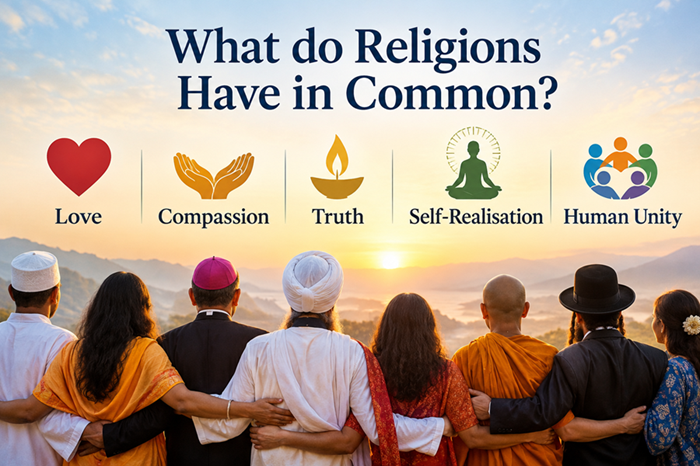
Religions have fought over God for centuries. But Christianity, Hinduism, Islam and Buddhism may have more in common than their followers admit: love, compassion, truth, self-realisation and human unity. OSWALD PEREIRA reports
Religions have spent centuries telling humanity what separates them. Perhaps the time has come to ask what brings them together.
Christianity, Hinduism, Islam and Buddhism do not teach the same theology. They do not worship in the same way, share the same scriptures or offer identical explanations of existence.
Christianity centres on Christ; Islam on submission to the one God; Hindu traditions encompass many paths to ultimate reality; Buddhism offers a path out of suffering without requiring belief in a creator God. To pretend these differences do not exist would make interfaith dialogue meaningless.

But difference need not produce hostility.
The Catholic Church itself underwent a profound change in its attitude towards other religions with the Second Vatican Council’s Nostra Aetate in 1965. It urged Christians to recognise the “truth and holiness” found in other religions and called for dialogue and cooperation with their followers. At the same time, it did not abandon Christianity’s claim about Christ. The Church continues to regard Christ as “the way, the truth, and the life.”¹
That distinction is important. Interfaith dialogue does not require Christianity to stop being Christian, Hinduism to stop being Hindu, Islam to stop being Islamic or Buddhism to surrender its distinctive philosophy. The purpose is not theological surrender. It is civilised coexistence—and, at its best, mutual enrichment.
Pope Leo XIV has continued this tradition. The Vatican’s recent commemoration of Nostra Aetate brought together representatives of Hinduism, Islam, Buddhism, Sikhism, Jainism, Judaism and other traditions around the themes of peace, fraternity and dialogue.² The message is difficult to misunderstand: religions should not become weapons in humanity’s endless wars of identity.
This is where the insights of India’s great spiritual teachers become remarkably relevant.
Sri Ramakrishna did not merely preach religious tolerance. He experimented with different spiritual paths and came to regard the world’s religions as different routes towards the same ultimate Reality. His famous analogy was simple: people may climb a roof by different staircases, but they reach the same roof.

Swami Vivekananda took this message to the West. At Chicago in 1893, he went beyond the conventional Christian idea of merely tolerating other religions. He spoke of accepting them. His vision was not of a world in which everybody became Hindu, Christian, Muslim or Buddhist, but of a world in which religions could coexist without demanding the destruction of one another.
Paramahansa Yogananda carried the same universalist spirit into the modern age. His teachings repeatedly sought the underlying harmony between the spiritual teachings of Krishna and Christ. For him, religious labels were secondary to direct spiritual experience. The divine was not the property of one civilisation or one scripture.
This is perhaps the most radical idea in interfaith dialogue: God does not belong to religions. Religions belong to humanity’s search for God.
There are obvious parallels among the great traditions. Christianity teaches love of one’s neighbour. Islam places enormous emphasis on charity, compassion and justice. Hinduism speaks of dharma, self-realisation and the unity underlying existence. Buddhism places compassion and freedom from attachment at the centre of the spiritual life.
The vocabulary differs. The destination may not always be described in the same way. Yet the moral challenge is remarkably similar: overcome greed, hatred, arrogance and selfishness; cultivate compassion; discipline the ego; serve others; search for truth.

That makes RSS Chief Mohan Bhagwat’s current message in the United States interesting—not because the RSS and the Catholic Church are equivalent, but because there is an unmistakable point of philosophical contact.
During his visit to New York, Bhagwat said that amid the world’s conflicts and divisions, “the only thing that unites us is consciousness. And that consciousness is Krishna Consciousness.”³ He has presented his New York appearance, the “Universal Oneness Celebration”, as an occasion centred on fraternity, harmony and dialogue.
At one level, that resonates strongly with the universalist tradition of Ramakrishna, Vivekananda and Yogananda. It also intersects with the Catholic Church’s post-Nostra Aetate insistence that religious differences should not prevent cooperation for peace and human fraternity.
But there is a crucial test.
Oneness cannot merely be a beautiful word. It has to include the person who does not believe what we believe.
It is easy to speak about unity among people who already share our civilisation, our scripture or our conception of God. The real test of interfaith universalism is the Muslim who disagrees with the Hindu, the Christian who disagrees with the Muslim, the atheist who rejects all three, and the Buddhist who does not accept the idea of a creator God. Can they all belong?
That is where interfaith dialogue either becomes genuine or collapses into religious self-congratulation.

The Pope’s position has an important lesson here. The Catholic Church has not solved the theological differences between Christianity and other religions—and does not pretend to have done so. Instead, it has tried to create a moral space in which those differences can coexist with respect.
India’s spiritual tradition offers an even more ambitious possibility: not merely tolerance, but the recognition that different spiritual paths may express different approaches to a reality larger than any single religious formulation.
Perhaps, then, the meeting ground between religions is not theology at all. It is humanity.
Religions may continue to disagree about revelation, salvation, reincarnation, resurrection, God, consciousness and the ultimate destiny of the human being. They should be free to do so. But they can still agree that hatred is destructive, compassion is better than cruelty, service is nobler than selfishness, truth is preferable to falsehood and human dignity cannot depend upon the religion into which a person happens to be born.

The world does not need religions to become identical. It needs them to become less insecure about their differences.
Ramakrishna offered spiritual intuition. Vivekananda gave it a global voice. Yogananda carried it across cultures. Nostra Aetate gave interfaith dialogue an institutional place within modern Catholicism. And Bhagwat’s language of universal oneness raises the same question in a contemporary Hindu context.
But there is one final test that every religion must face.
If my God is truly infinite, why should I be threatened by another person’s path to the Infinite?
That question may be more powerful than any theological argument. It moves religion from competition to conversation, from possession to pilgrimage, and from the claim that my path alone is sacred to the humbler possibility that truth may be too vast for any one religion to possess.
Notes
- Second Vatican Council, Nostra Aetate (1965), which simultaneously affirms Christ as “the way, the truth, and the life” and calls Christians to dialogue and cooperation with followers of other religions.
- Dicastery for Interreligious Dialogue, Vatican, programme marking the 60th anniversary of Nostra Aetate, October 2025.
- Mohan Bhagwat, remarks at ISKCON, New York, August 28, 2026.

