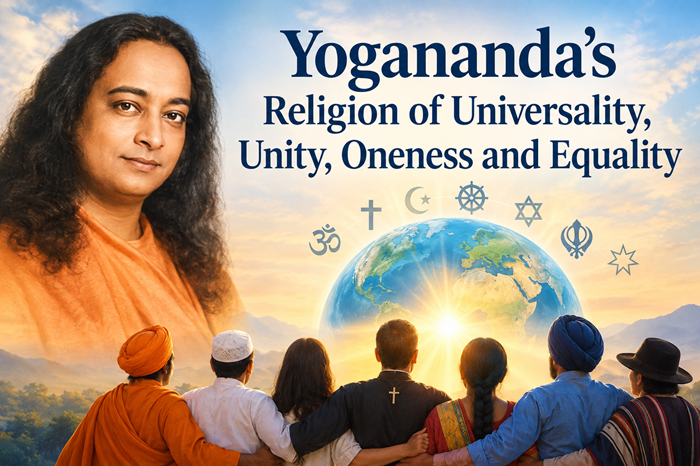
One God, one universal religion, many paths to the Divine. OSWALD PEREIRA explores Paramahansa Yogananda’s profound message that religions are not separate truths, but different paths towards one spiritual reality
Yogananda was not a conventional or traditional yogi but a revolutionary one. He gave a new expression to religion by blending the best practices in all religions, treshing out the dogmas and doctrines not in tune with the freedom of spirit.
In Yogananda’s religion there is no hell, for he doesn’t see God as a judgmental, retributive, fire-spouting superior Being sitting on a fancy, golden throne, high in the heavens above. The yogi doesn’t believe that humans are sinners, because we are all God’s children, built in His image. He keeps reminding us that “a saint is a sinner who never gave up.”
In Sri Ramakrishna’s spiritual vocabulary, too, there was no such word as ‘sin’; there was also no such word as ‘blasphemy.’ Therefore, there was no condemnation of anybody.
In the Bible, we read: “For in the image of God made He man.” God is Spirit and man in his essential nature is also Spirit, observes Yogananda. “That is the primary meaning of the Biblical passage,” explains Yogananda.
He elaborates: “The whole human body and the consciousness and motion in it are a microcosmic representation of God. By virtue of the consciousness within man, therefore, he may be said to be made in the image of God.
All the attributes that God has―consciousness, reason, will, feeling love―man has too. In these qualities man may be said to be made in the image of God.”
In Yogananda’s religion, God is a friend, philosopher and guide―a beloved, who stays with us for better or for worse, through thick and thin, not only in this life, but for eternity; for millions of births till we finally find Him and merge with His Infinite Spirit.

In Yogananda’s God-friendly religion, we can talk to God, if we sincerely desire so with our whole heart, mind and soul. In the very first lines of his book, How You Can Talk With God, Yogananda says, “Talking with God is a definite fact.” He adds that in India he has been in the “presence of saints while they were talking with the Heavenly Father.”
But God extends that privilege to “all” his people, “who may communicate with him; not a one-sided conversation but a real talk wherein you speak to God and He responds.”
Yogananda believes that “God does appear to us in physical form.” He assures us, “He is more personal than you can imagine. He is as real and actual as you are.”

Sri Ramakrishna said: “God can be seen and spoken with, just as I am seeing you and speaking with you…If any one is in truth equally anxious to see Him and calls on Him with a longing heart, He certainly reveals Himself to him.”
Yogananda adds: “God talks to you when you are working for Him, and you should speak to Him constantly; and say to Him, ‘Lord reveal Thyself.’ Let Him know that you will never be satisfied until you have Him. Finally, He will give you an answer. In a vision you may see a face of some saintly being, or you may hear a Divine Voice talking to you; and you will know that you are in communion with God.”
However, we can conceive a scenario where we are in conversation with God, only when we interact with Him on a daily basis, every hour, and when we reach a higher plane, minute-by-minute.
As Yogananda writes in his book, The Science of Religion: “If we do not emphasize the necessity of God in every aspect of our lives and religion in every minute of our existence, then God and religion drop out of our intimate daily consideration and become only a one-day-in-a-week affair.”
Saint or sinner, rich or common man, we are all equal in the eyes of God, Yogananda tells us.

This sense of equity―fairness or equality―is a predominant part of Yogananda’s religious teachings.
It is this same sense of fairplay or equality that prompts Yogananda to say that while Jesus is the Son of God, we all have it in us to become Sons of God. This is an important part of the guru’s religious philosophy.
As Yogananda explains in his book, The Divine Romance: “When St John said, ‘as many as received him, to them he gave the power to become Sons of God,’ (John 1:12) he meant that anyone who could receive that Christ Consciousness, who could increase the capacity of his consciousness, to hold that infinite ocean of truth, would become as Jesus did, a Son of God―one with the Father.”
The Science of Religion is a book that records Yogananda’s historic lecture, his maiden speech in America, at an international conference of world religious leaders in Boston in 1920, when the then young yogi was India’s representative at the event.
Importantly, the book aims to point out the universality and unity of religion, and asks a very pertinent question, which has since become an integral part of Yogananda’s religious creed.
The question: When there is one God, why should there be so many religions? The book gives a brief, historical perspective of this anomaly.

“There have been different religions in different ages,” the book notes. There is nothing wrong in this per se. But what is wrong is the fact that “There have been heated controversy, long warfare and much bloodshed over them.”
This has happened because, “one religion has stood against another, one sect has fought with another.” The problem has been compounded because, “not only is there a wide variety of religions, but there is also a wide variety of sects and opinions within the same religion.
In his book, The Holy Science, written in 1894, Yogananda’s guru, Sri Yukteswar endeavours to “show as clearly as possible that there is an essential unity in all religions; that there is no difference in the truths inculcated by the various faiths; that there is but one method by which the world, both external and internal, has evolved; and there is but one Goal admitted by all scriptures.”
“The object of this book is to point out the harmony underlying the various religions, and to help in binding them together,” Sri Yukteswar adds.
Particular stages of intellectual growth and thinking among nations, owing to different geographical locations, may have determined the origin of different religions such as Hinduism, Islam and Christianity, Yogananda observes.
“If by religion we understand only practices, particular tenets, dogmas, customs and conventions, then there may be ground for the existence of so many religions,” he adds.
But “If religion means primarily God-consciousness, or the realization of God both within and without, and secondarily a body of beliefs, tenets, and dogmas, then, strictly speaking, there is but one religion in the world, for there is but one God,” contends the wise yogi and avatar, arguing out his case for universality, oneness and unity of religions.
“If God is one, necessary to all of us, so religion is one, necessary and universal,” reasons Yogananda. “Only the roads to it may differ in some respects at the beginning,” he adds.
Further stating his case for universality, he points out: “it is illogical to say that there are two religions, when there is but one God. There may be two denominations or sects, but there is only one religion. What we now call different religions should be known as different denominations or sects under that one universal religion.”

