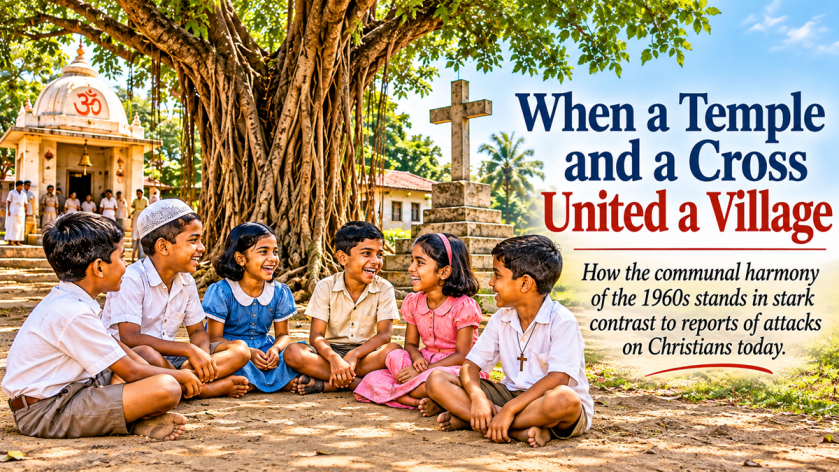
How the communal harmony of the 1960s stands in stark contrast to reports of attacks on Christians today.
Recalling the communal warmth of the 1960s, OSWALD PEREIRA revisits a childhood where faiths mingled freely—and asks why Christians now gather in protest against attacks on their places of worship
Way back in the 1960s, in our village Kolbad in Thane, Maharashtra, we children hardly knew the difference between religion, caste, creed or class. Hindu, Muslim and Christian children played, laughed and grew up together. I was barely in my teens, but those memories remain among the happiest of my childhood.
Our favourite meeting place after school was an ancient banyan tree. It offered generous shade and had enough room to accommodate our entire gang of youngsters. It was our unofficial clubhouse, where religion never came up as a dividing line.
The only day we did not occupy our usual spots under the tree was during the annual Wad Puja. On this day, elegantly dressed women, in their finest sarees and jewellery, would go around the banyan tree, wrapping it with sacred thread and offering aartis. They prayed for their husbands’ long and healthy lives, symbolically blessing them with the strength and longevity of the sturdy tree.

Behind the banyan tree stood a Shiva temple. The ringing of its bells was music to our ears. But we continued our childish conversations even as devotees walked in and out, offering their prayers. The temple was part of our everyday surroundings, as familiar to us as the tree under which we played.
Barely 30 feet away stood the village well. Children and adults alike swam in it. Labourers employed in mills and factories, who lived in nearby hutments and had no access to public taps or other sources of water, also used the well. They bathed there and carried water home in the same buckets they used for bathing. Nobody thought much about these everyday arrangements. The well belonged to the village, and the village belonged to everyone.
The well also played a special role in Catholic weddings. A day before the wedding, water was drawn from it as part of an age-old custom called Umbracha Pani. The bride-to-be and other women in the family dressed in traditional pink sarees and danced their way to the well. Relatives and friends followed, dancing behind the bride under a pink umbrella.
The well would be decorated with white strips of paint to mark the occasion. Before proceeding to the church, the marriage party would also visit the Shiv Mandir to pay obeisance. My grandmother told me that the Catholic ancestors of the village had been Hindus centuries ago. Many Hindu customs had, therefore, continued across generations.
But perhaps the strongest evidence of our communal harmony emerged every evening, when boys belonging to different faiths gathered at the cross in the centre of the village. We sat on its steps, chatting and laughing. Unlike the expansive banyan tree, however, the cross was not large enough to accommodate the entire gang. Latecomers had to stand!
Nobody found anything unusual about children gathering under a banyan tree, near a Shiva temple or on the steps of a Christian cross. These were simply different parts of our village, all equally familiar and welcoming.
A Simple Life, Rich in Togetherness

Our entertainment was equally uncomplicated. Hindi films at Prabhat Talkies, the only cinema theatre in town, were a major attraction. Pocket money was limited, so we watched movies from the front rows, sitting on wooden benches. Tickets cost five annas and, later, 50 paise.
The only public transport within the city was the tonga, which we children could not afford. So we walked everywhere, including to the cinema.
Life at home was equally simple. My mother cooked on a kerosene stove, while my grandmother, who lived in a neighbouring house, used firewood and clay pots. Grandma’s food was delicious—indeed, tastier than Mom’s! She always saved a generous portion for me because I was her favourite grandchild.
We had no refrigerator. Water stored in earthen matkas tasted as fresh as nectar. There was no television, and we did not even own a radio.
Looking back, I sometimes wonder whether we were richer in those days, despite having so little. Our lives were uncomplicated, our friendships uncomplicated, and our sense of belonging extended beyond the boundaries of religion.
Education Without Religious Barriers

Communal harmony was also reflected in our education. Hindus, Muslims, Christians and children from other communities studied together at St John the Baptist High School in Jambli Naka, in the heart of Thane. Run by priests of the Secular Order, the co-educational school was immensely popular.
Holy Cross Convent, an all-girls school in Katarwadi, away from the main town and run by nuns, was also gaining popularity. Girls from different communities chose to study there.
For higher education, Christian-run institutions in Bombay, now Mumbai, attracted students from across communities. St Xavier’s College was a popular co-educational institution, while Sophia College for Women offered higher education to young women.
Students who graduated from these colleges cherished their alma maters with pride. I graduated with Honours in Economics from St Xavier’s College and was proud to be associated with it. My friends from different faiths and communities felt equally proud of their educational institutions.
Nobody considered a Christian-run college an institution exclusively for Christians, just as nobody thought a Hindu temple or a church was a place where people of other faiths did not belong.
A Troubling Contrast With Today

I recall these childhood memories with affection, but also with sadness when I read reports of growing hostility towards Christian communities in different parts of India.
A news report from Kolkata, dated November 5, 2026, stated:
“Thousands of Christians representing 11 states across India gathered in Kolkata on Thursday, November 5, for a six-kilometre prayer rally organized by the Bangiya Christiya Pariseba (BCP), calling for peace, religious freedom and an end to attacks on Christian communities and places of worship.

“The rally took place amid growing concerns over incidents of harassment of Christians, attacks on prayer gatherings, vandalism of churches and desecration of religious objects. Participants used the gathering to express solidarity and call for peaceful coexistence and respect for religious freedom.”
The report is deeply disturbing. Why should members of a religious community have to take to the streets in a prayer rally to demand the freedom to worship without fear? Why should churches, prayer gatherings and religious objects become targets of hostility?
Who is responsible for these attacks? Are they isolated incidents, or do they point to a larger pattern of intolerance? Why are such incidents being reported with such intensity today?
These questions cannot be brushed aside. Nor should the concerns of Christians be dismissed as the anxieties of a minority community. Freedom of religion and the right to practise one’s faith are fundamental to India’s constitutional promise.
My memories of Kolbad are not an argument that the past was perfect. Every generation has had its shortcomings. But I remember a time when a Hindu, a Muslim and a Christian child could share the same playground, the same well, the same school and the same friendships without having to explain or defend their identities.
The banyan tree did not ask our religion before offering us shade. The village well did not discriminate when we drew water. The Shiva temple and the Christian cross stood within a few steps of each other, without either diminishing the other.
That was communal harmony—not a slogan, not a political promise, but a way of life.
India must ask itself an uncomfortable question: Have we lost something precious that generations before us took for granted?
A country that cannot protect the right of every community to pray in peace risks losing something far more valuable than religious harmony. It risks losing its humanity.

