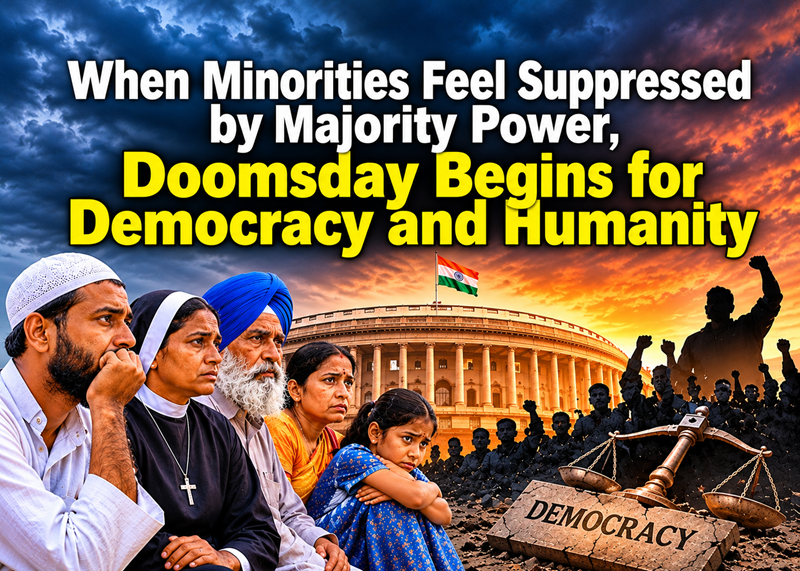
When majority power becomes an instrument of minority oppression, democracy loses its soul and humanity its conscience. The warning signs must never be ignored, writes OSWALD PEREIRA
The majority has the numbers to govern. It does not have the right to dominate. Winning an election gives a political party the authority to form a government, not a licence to trample upon the rights of those who did not vote for it. This distinction lies at the heart of constitutional democracy.
The danger begins when numerical strength is mistaken for moral superiority. When a majority uses its political power to silence dissent, marginalise communities or deny minorities equal rights, it ceases to uphold democracy and begins to destroy it.
To put it bluntly, the suppression of minorities by the majority signals the doomsday not only of democracy but of humanity itself.
This issue is particularly relevant for India. We are a country of extraordinary religious, linguistic, cultural and philosophical diversity. India’s religious minorities include Muslims, the largest minority community, followed by Christians, Sikhs, Buddhists, Jains and Parsis, among others. These communities are not outsiders seeking accommodation. They are integral to India’s history, civilisation and national identity.
Their right to practise their faith, preserve their traditions, educate their children and participate fully in public life is not a concession from the majority. It is guaranteed by the Constitution and grounded in the fundamental principle of human equality.
Democracy Is Not the Rule of Numbers

Elections determine who governs; the Constitution determines the limits of that power. A government may enjoy an overwhelming electoral majority, but it remains answerable to constitutional principles. It cannot turn its mandate into an instrument for discriminating against citizens on grounds of religion, language, caste or belief.
The Constitution of India guarantees equality before the law, freedom of religion and the right of minorities to protect their culture and establish educational institutions. These are not decorative provisions. They are essential safeguards against the tyranny of numbers.
A government representing the majority must remember that it governs the entire country, not merely those who voted for it. The opposition has every right to question government decisions, organise protests and challenge policies in court. Such dissent is not an attack on democracy. It is democracy at work.
No Citizen Should Live in Fear of Practising Their Faith

The true measure of a civilised society is whether a person belonging to a minority can practise a religion, express an opinion, celebrate a festival and raise a family without fear. No citizen should feel compelled to prove patriotism because of the religion he or she follows.
Muslims, Christians, Sikhs, Buddhists, Jains and Parsis must enjoy the same dignity, security and freedom as members of the majority community. An attack on a place of worship, intimidation over religious practices, discrimination in public life or the targeting of individuals because of their faith is an assault on the constitutional promise of equality.
This does not mean that minorities are above the law. Every citizen, irrespective of religion, must obey the same laws and be accountable for individual actions. But the law must never become an excuse for collective suspicion, discrimination or punishment of an entire community.
Nor can religious freedom survive in an atmosphere where hatred is normalised, prejudice is politically exploited and those who speak up for vulnerable communities are treated as adversaries.
A Nation’s Greatness Lies Beyond Its Numbers
India’s civilisational heritage offers a powerful reminder that diversity need not lead to division. Its traditions have accommodated different beliefs, schools of philosophy and spiritual paths across centuries. The principle of coexistence is not a weakness to be overcome; it is a strength to be preserved
There is a profound difference between possessing power and knowing how to use it. A majority that humiliates minorities may win elections, but it loses the moral authority to call itself democratic. The true greatness of a society lies in its capacity to recognise the equal worth of every human being, regardless of religion, identity or social standing.
Ultimately, democracy is not simply about who wins an election. It is about whether those who lose continue to enjoy their rights and continue to be treated with dignity.
When the majority community uses its numbers to suppress minorities, something far more precious than political freedom is destroyed. The idea that all human beings are equal begins to crumble.

Once we begin to believe that some people deserve fewer rights because they belong to a smaller community, we abandon the very foundation of civilisation.
A majority that uses its power to protect the constitutional rights of all citizens strengthens the nation. A majority that uses its numbers to persecute minorities takes democracy down a dangerous road towards its destruction.
The doomsday of humanity will not necessarily arrive with a nuclear explosion or a global catastrophe. It can begin quietly, when one community is made to feel less human than another, and civil society looks away.
A democracy is truly great when citizens of all faiths are equal in dignity and freedom.
When we deny another human being his freedom and dignity, we imperil not only our own humanity, but the humanity of all.

