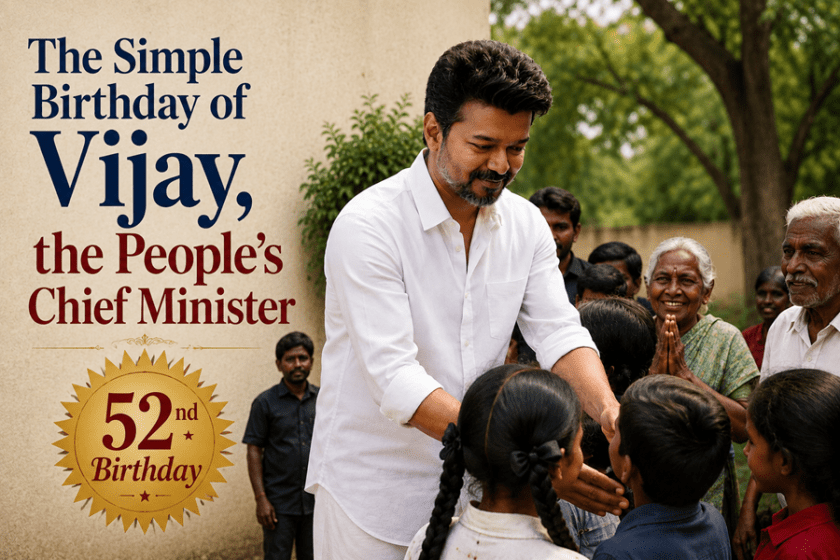
OSWALD PEREIRA reports on Tamil Nadu Chief Minister C Joseph Vijay’s simple, non-lavish birthday celebrations. No fireworks, no extravagance, no political spectacle. Vijay’s simple 52nd birthday revealed the secret behind his extraordinary mass appeal: authenticity, humility, and service
When Tamil Nadu Chief Minister C Joseph Vijay turned 52 on June 22, the state witnessed something increasingly rare in contemporary politics: restraint.
There were no extravagant birthday celebrations. No deafening fireworks. No giant cakes. No lavish displays of power or personality. Instead, the day passed with quiet simplicity. More significantly, resources that could have been spent on festivities were channelled towards charitable activities for the poor and needy.
While grassroots supporters and party cadres organised regional welfare programmes and events, Vijay spent quiet, personal time with his parents, veteran filmmaker S A Chandrasekhar and singer Shoba Chandrasekhar, who visited him at the Chennai Secretariat.

Rather than organising lavish banquets and extravagant festivities, the government announced a series of public-oriented initiatives, including two days of free entry to the Vandalur Zoo for families and children. Echoing Vijay’s call for simplicity and service, local Tamilaga Vettri Kazhagam (TVK) cadres replaced towering birthday billboards with welfare activities, distributing Annadhanam (free meals) and essential supplies to the needy across several districts.
Vijay’s early legislative addresses have carried a clear and consistent message: his government belongs to the common citizen. He has repeatedly highlighted that his party was forged through years of welfare work by dedicated fan-club volunteers, not handed down through the corridors of dynastic politics or elite power structures.
Days before his birthday, Vijay’s administration drew praise for scrapping 46 commercial projects worth ₹246 crore that were to be financed through temple funds. Citing the financial strain such projects would impose on the institutions, the decision surprised many and earned approval from critics who had previously viewed his government with scepticism.

Despite the Chief Minister’s low-key personal celebration, TVK workers in Sivakasi—India’s fireworks capital—could not resist a spectacular, one-hour continuous fireworks display on the eve of his birthday to celebrate their historic election victory.
Amid widespread chatter over a supposed social media “unfollow” episode, Trisha Krishnan silenced the rumours in the most effortless way possible—by posting a midnight birthday picture of Vijay beaming beside his cakes, much to the delight of fans and in keeping with a long-standing annual tradition. The cakes were from Trisha and Vijay had no hand in their appearance.
Upon taking office, Vijay had wasted little time in translating campaign promises into action, rolling out 200 units of free power for every household, launching a tougher crackdown on drug-related crimes, and creating a specialised unit focused on women’s safety and security.

In a political culture where birthdays of leaders often resemble grand public festivals, Vijay’s understated observance stood out precisely because it was so different.
Yet for those who have followed his journey—from beloved actor to one of India’s most popular political leaders—this simplicity came as no surprise. It is not a carefully crafted image. It is part of who he is.
Despite commanding immense popularity, Vijay continues to carry himself with the ease of a neighbour from down the street rather than a politician occupying one of the most powerful offices in the country. His famous words, “I am like one of you, an ordinary person,” are not merely a slogan. They are reflected in the way he lives and works.
Stories abound of the Chief Minister preferring simple, home-cooked meals and often eating lunch at his desk while continuing to work through files. There is something refreshingly unpretentious about a leader who chooses productivity over ceremony and duty over display.
This quality has become one of Vijay’s greatest political strengths. People do not merely admire him; they identify with him.
His appeal is rooted not only in charisma but also in relatability. Millions see in him someone who, despite fame, success, and power, has retained the habits and sensibilities of an ordinary citizen. In an era when many political leaders appear distant from everyday life, Vijay seems remarkably accessible.

Perhaps that is why his rise has resonated so strongly with Tamil Nadu’s youth and working classes. They see a leader who does not project superiority. Instead, he projects familiarity. He speaks not from a pedestal but from within the crowd.
This “boy-next-door” quality has been a defining feature of Vijay’s public persona for decades. As an actor, it helped him connect with audiences far beyond the cinema hall. As Chief Minister, it has translated into a powerful political asset. People feel that they know him. More importantly, they feel that he knows them.

One could legitimately ask: how many chief ministers in South India—or indeed across India—can claim such a reputation for personal simplicity while occupying the highest office in their state? Power has a way of insulating leaders from ordinary realities. Vijay appears determined not to let that happen.
The simplicity of his birthday celebration may seem like a small detail. Yet small details often reveal the most about a person’s character. A leader who chooses charity over extravagance sends a message far more powerful than any fireworks display could ever convey. It is a reminder that public office is ultimately about service.
Vijay’s popularity cannot be explained by his celebrity status alone. Many stars have entered politics; few have managed to inspire the kind of emotional connection he enjoys. The secret lies in a rare combination of star power and humility, charisma and accessibility, leadership and humanity.
At 52, C Joseph Vijay remains what he has always claimed to be—one among the people. And perhaps that is why, to millions, he is not merely the Chief Minister of Tamil Nadu. He is the Chief Minister with a mass appeal that springs from something deeper than politics: authenticity.

