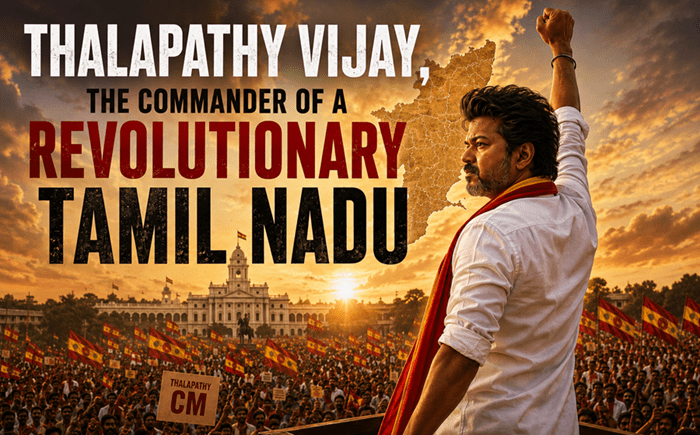
More than a reformer, populist, or visionary, Tamil Nadu Chief Minister C Joseph Vijay has emerged as a catalyst of political change. Through his model of inclusive governance, Tamil Nadu is poised to redefine the future of democratic politics across India, observes OSWALD PEREIRA, in his new, upcoming book
My new book, The Vijay Revolution: People Power & the Politics of Hope, is set to hit bookshops later this month. The book asks a defining question: Is Vijay’s rise merely another chapter in Tamil Nadu’s history of film stars entering politics, or the beginning of a new, revolutionary political era?
This book traces the extraordinary journey of C Joseph Vijay—popularly known as Thalapathy, ‘The Commander’—from child artiste and superstar to Chief Minister of Tamil Nadu. More than a biography, it is an incisive exploration of how Vijay challenged entrenched political structures, redefined public expectations, and inspired a new political order centred on dignity, welfare, opportunity, and citizen participation.
At the heart of Vijay’s appeal is his ability to transcend traditional political divides and forge a direct bond with the people. The book examines how that connection transformed fandom into a powerful democratic movement and positioned Vijay as a symbol of hope and renewal.

More than a reformer, populist, or visionary, Vijay has emerged as a catalyst of political change. Through his model of inclusive governance, Tamil Nadu is poised to redefine the future of democratic politics across India.
Key Features of the Book
Follows Vijay’s extraordinary journey from child artiste to ‘Thalapathy’.
Shows how cinematic influence evolved into political capital.
Charts the rise of a fan movement into a formidable electoral force.
Chronicles the campaign that disrupted Tamil Nadu’s six-decade political status quo.
Examines the transition from electoral triumph to the realities of governing a state.
The Morning Tamil Nadu Changed
At dawn on 10 May 2026, the roads leading to Fort St. George, the seat of the Tamil Nadu government, were already overflowing. Party workers carrying (Tamilaga Vettri Kazhagam) TVK flags stood shoulder to shoulder with lifelong film fans wearing old Vijay movie T-shirts faded by decades of devotion.
Women broke coconuts outside roadside shrines. College students painted “Thalapathy CM” across flyovers and walls. Tea shops replayed scenes from his films beside live television coverage of the oath-taking ceremony. Tamil Nadu had witnessed cinematic politics before. But never quite like this.

When Chandrasekaran Joseph Vijay finally stepped forward to take his oath as Chief Minister of Tamil Nadu, the moment seemed almost unreal—even to those who had campaigned for him.
For years, political observers had argued that the age of superstar-politicians was over. The Dravidian giants had institutionalised power, and elections had become battles of organisation rather than emotion. Vijay shattered those assumptions.
His party, TVK, was barely two years old. He lacked the organisational machinery of the DMK, the welfare legacy of the AIADMK, and any administrative experience. Yet he achieved what nationally celebrated figures like Rajinikanth and Kamal Haasan could not—he won power.
By afternoon, Vijay’s victory had become a national political story. To young voters, he represented aspiration and generational change. To sections of the middle class, he symbolised clean governance and anti-corruption politics. To minorities, he offered reassurance in an era of growing religious polarisation. To Tamil nationalists, he embodied regional pride. And to millions of fans, the victory felt deeply personal.
What made the moment especially significant was Vijay’s unusual public identity. Born into a Christian family yet deeply immersed in Tamil Hindu cultural symbolism, he emerged as perhaps India’s first major “Christian-Hindu” Chief Minister. His political language blended temple traditions, church heritage, secular rhetoric, and Tamil cultural pride into a distinctive plural vision.
This book traces Vijay’s journey from a child actor dismissed as a product of nepotism to one of South India’s most influential cultural figures and finally the elected leader of Tamil Nadu. It is the story of cinema transformed into political power, of fandom evolving into democratic mobilisation, and of a state where the boundary between the silver screen and history remains remarkably thin.
In Tamil Nadu, the hero may always win in the final reel. In politics, however, there is no “The End”—only the relentless reality of governance.

