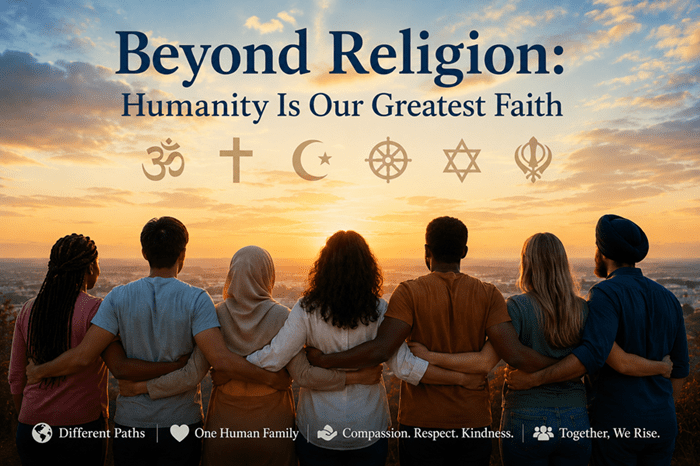
In an age when religious identity seems to rule our lives, the best option is to quietly transcend conventional labels, and adopt the belief that humanity itself is the most enduring faith, says OSWALD PEREIRA
There was a time when religion was expected to soften the human heart. It encouraged compassion over conflict, humility over pride and service over self-interest. The founders of the world’s great faiths did not ask humanity to build walls around God. They invited us instead to discover the divine presence within ourselves and in one another.
Yet today, religion often seems to occupy an altogether different space. It has become the vocabulary of politics, the currency of elections and, too often, the fault line that separates neighbour from neighbour. Public discourse is increasingly framed in terms of religious identity, and the nation itself is frequently viewed through the narrow lens of communities labelled as “majority” and “minority.”
One wonders how we arrived here.
Who benefits when people begin to fear one another because they pray differently—or choose not to pray at all? Why has religious identity become more important than human identity? And who keeps nurturing the narrative that one community must inevitably feel threatened by another?
The very language of “majority” and “minority” deserves thoughtful examination. Numbers, by themselves, do not determine justice, nor do they confer moral superiority. Is it logically possible for a minority to dominate a majority merely because it is numerically smaller? Or are such anxieties often sustained by selective history, political expediency and the perpetual search for convenient divisions?
These are not questions to be answered with slogans. They deserve reflection.
Perhaps the greatest irony is that many modern families no longer fit the rigid religious categories that dominate public debate.
Mine certainly does not.
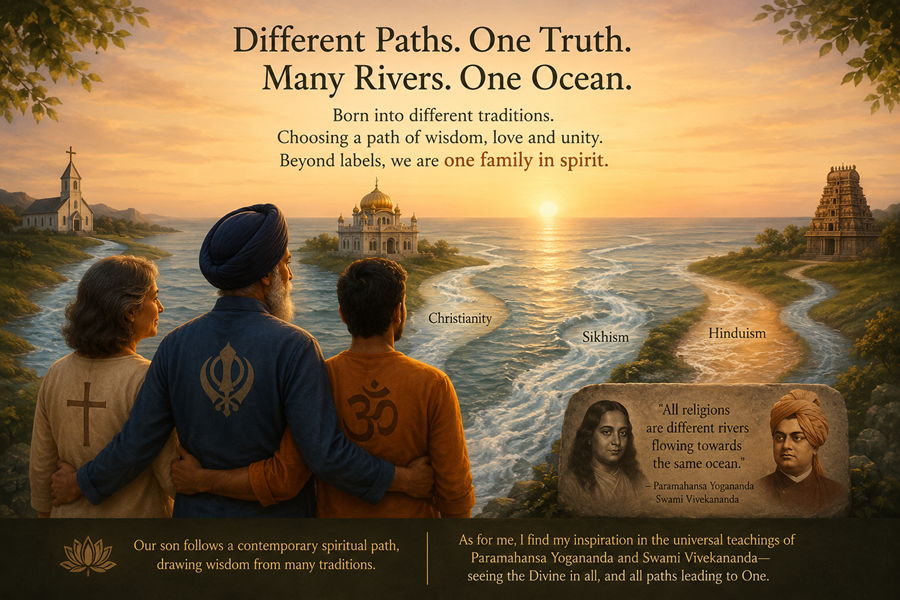
I was born into a Christian family. I married a Sikh. Our son married a Hindu. Yet, if one looks beyond the labels inherited at birth, the story becomes far more interesting.
Our son follows neither Christianity, Sikhism nor Hinduism. His spiritual journey has led him towards a contemporary path that draws wisdom from several traditions. As for me, I no longer identify with any organised religion. My spiritual outlook has been shaped by the universal teachings of Paramahansa Yogananda and Swami Vivekananda, who saw all genuine religions as different rivers flowing towards the same ocean.
My wife, too, quietly practises what resonates with her soul. She finds inspiration in prayers, meditation and spiritual disciplines drawn from different Indian traditions. She has never felt the need to confine herself within a single religious boundary.
So what religion are we?
It is a surprisingly difficult question.
If tomorrow we were required to fill in a government form or a census document asking us to state our religion, what would we honestly write? Christian? Sikh? Hindu? None would faithfully describe who we are today.
Perhaps the most truthful answer would simply be: No Religion.
Or perhaps: Universalist.
Would such an answer be accepted?
I honestly do not know.

Official systems naturally depend upon categories. Human beings, however, often refuse to remain inside neatly drawn boxes. Increasingly, millions across the world are discovering spirituality without feeling obliged to belong exclusively to one organised religion. They read the Bhagavad Gita alongside the Bible. They draw inspiration from Guru Nanak, the Buddha, Kabir, Rumi and countless other seekers whose wisdom transcends geography and doctrine.
Their search is not for any identity.
It is for truth.
India’s Constitution wisely recognises freedom of conscience. That freedom surely includes not only the right to profess a religion but also the freedom to embrace the universal truths that flow through all religions. Such choices should enrich our democracy, not complicate it.
Sadly, the present climate often leaves thoughtful citizens confused, and sometimes even hesitant to express their deepest convictions. This is unfortunate, because fear has never been the language of authentic religion. The language is Love.
Perhaps we have spent too much time debating which path is superior, and too little time asking whether we are becoming kinder, more truthful and more compassionate human beings.
There is an old spiritual insight that continues to resonate across traditions: there is no religion in the House of God.
The Upanishads proclaim that Truth is One. Jesus speaks of the many mansions in the Father’s house. Guru Nanak reminds us that there is but One Creator. The Buddha asks us to conquer hatred with love. The mystics of every civilisation point beyond labels towards direct experience.
They are all inviting us to the same destination.

The practical world may continue asking us to tick boxes. Governments may continue classifying citizens. Political rhetoric may continue dividing society into competing identities.
But our inner life need not be imprisoned by those divisions.
The highest calling of religion has never been to persuade us that God belongs to one community. Its purpose has always been to awaken the awareness that every human being belongs to God.
If God becomes more important than our identities, if compassion becomes stronger than suspicion and if our shared humanity begins to matter more than inherited categories, then religion will once again become what it was always meant to be—not a badge of separation, but a bridge of understanding.
In the timeless words of Swami Vivekananda, at his historic address at the World’s Parliament of Religions in Chicago on September 11, 1893: “We believe not only in universal toleration, but we accept all religions as true.”
In these few words, lies a quiet path towards a less fearful, less divided and infinitely more human world.

