OSWALD PEREIRA makes out a strong case for restoring pride in our spiritual heritage, without seeking Western validation. India must stop seeking external approval for her gurus and saints and start listening to her own soul. Only when Indians recognise the value of their gurus not because the world applauds them, but because they are grounded in dharma, will we mature spiritually
India gave the world yoga, meditation, Vedanta, and a galaxy of saints who spoke of truth beyond borders. Yet, 78 years after Independence, too many Indians still wait for the West to applaud before honouring their own spiritual heritage. A guru trends on social media in Los Angeles, and only then does he become a household name in India. This is not confidence—it’s a colonial hangover.
The Chicago Syndrome
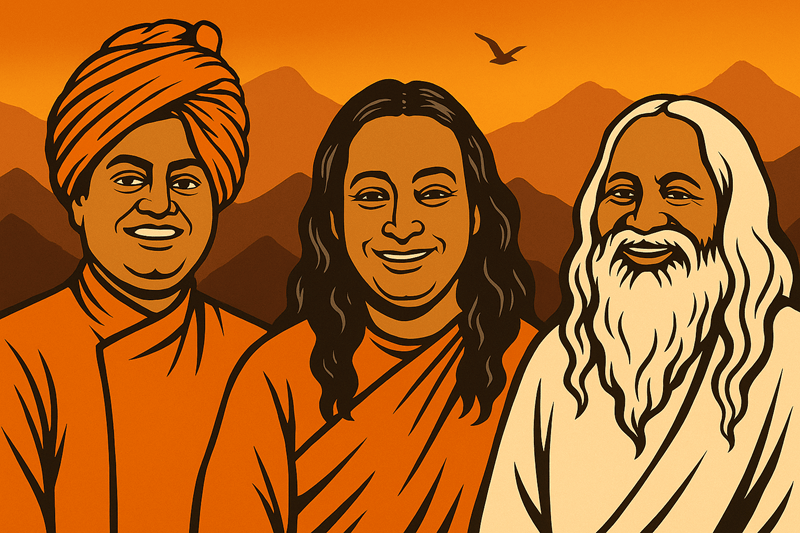
In 1893, Swami Vivekananda’s electrifying speech in Chicago stunned America. Back home, only then did Indians wake up to his genius. It’s a pattern that has repeated itself: Paramahansa Yogananda, Maharishi Mahesh Yogi, even today’s celebrity gurus often found fame abroad first.
Sociologist Dipankar Gupta calls this “a mimetic desire for modernity”—a need for foreign applause to feel proud of what is ours. The ghost of Macaulay’s colonial education system still haunts us, conditioning Indians to distrust their traditions unless they are stamped with Western approval.

Truth Doesn’t Need Branding
The irony is that true spiritual power has never needed slick marketing. Neem Karoli Baba lived in obscurity, yet his wisdom inspired Steve Jobs and Ram Dass. Ramana Maharshi never left India, but seekers worldwide came to him. Amma’s hugs draw millions, while ISKCON’s Swami Prabhupada spread bhakti across continents.
These masters didn’t need branding strategies or TED Talks. They proved that authenticity, not applause, makes spirituality universal.
The Age of Spiritual Neoliberalism
Today, spirituality risks becoming just another commodity. Yoga is sold as a fitness fad. Vedanta is trimmed into Instagram quotes. Gurus are rebranded as lifestyle coaches. What was once a rigorous discipline of mind and spirit is now a billion-dollar “wellness” industry.
This is spiritual neoliberalism: ancient wisdom flattened into marketable content. India’s saints are reimagined to suit Western tastes—sanitised, stripped of ritual, and sold back to us like exotic souvenirs.

Reclaiming Confidence
India doesn’t need to isolate itself to regain spiritual confidence. Our wisdom is inherently universal. But sharing doesn’t mean self-erasure. Universal truths should be expressed with depth and dignity, not in soundbites.
The real revolution must begin in education. Indian schools rarely teach their own spiritual heritage seriously. We produce engineers who can code in five languages but can’t explain the philosophical roots of yoga. Bringing Sanskrit texts, comparative religion, and Indian philosophy into curricula—alongside global thought—would be a start.
A Blueprint for Renewal
To reclaim spiritual leadership, India needs bold reforms:
Spiritual Education: Teach classical Indian philosophy in schools and universities.
Accredited Gurukulas: Blend scriptural rigour with modern disciplines.
Leadership Training: Prepare spiritual leaders in ethics and social responsibility.
Media Literacy: Educate people to spot genuine wisdom over charisma.
Funding and Archives: Support research in Vedanta, Yoga, Tantra, Bhakti, and preserve spiritual history.

The Politics of Validation
Spiritual recognition today is often mediated by global platforms. A guru featured in Time or on Oprah’s stage carries more weight in Indian public opinion than one steeped in scripture. This obsession with external validation is a subtle form of neo-colonialism—our saints are repackaged, and our traditions are “approved” by outsiders.
It’s time India flipped this script.
Vivekananda’s Challenge to Us
When Vivekananda declared in Chicago, “I am proud to belong to a religion which has taught the world both tolerance and universal acceptance,” he wasn’t seeking applause. His confidence came from conviction, not Western approval.
Today, India must rediscover that voice. Spiritual renewal won’t come from celebrity endorsements or Netflix documentaries. It will come when Indians trust their sages, scriptures, and traditions because they are true—not because they are trending.

Self-Born, Not Outsourced
The rishis of old didn’t need retweets or headlines. They sought truth in forests, caves, and quiet corners of India—and their insights echoed across millennia. If we reclaim that inner strength, the world will still listen, because authenticity has its own gravity.
India’s spiritual renaissance will never be complete if it relies on foreign applause. It must rise from within, rooted in dharma and alive to modern realities. Only then will we stop outsourcing our soul and start leading from it.
When Indians recognise the value of their gurus not because the world applauds them, but because they are grounded in dharma, India’s spiritual renaissance will no longer be outsourced—it will be self-born.
India must stop seeking external approval for her saints and start listening to her own soul.
Featured Image: Did Vivekananda, Yogananda and Maharishi Mahesh Yogi, really need foreign approval?
Some images are AI generated
 OSWALD PEREIRA