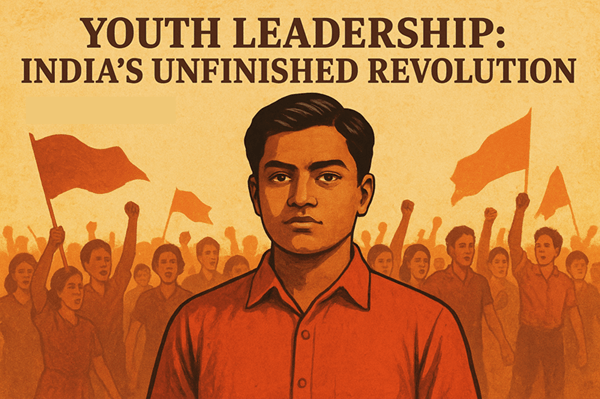
Swami Vivekananda had visualised the youth rising and playing a leading, revolutionary role in nation-building, says OSWALD PEREIRA. More than 120 years since his passing away, the question still burns: have the youth risen—or been allowed to rise—to the challenge of leading the nation?
Swami Vivekananda saw the youth not merely as a demographic category but as a spiritual and moral force capable of reshaping India. For him, nation-building was ultimately a project of character-building, and it was the young—free of cynicism, caste rigidity, or submissive colonial mentality—who could ignite that transformation.
In his celebrated exhortation, “Give me a few men and women who are pure and selfless, and I shall shake the world,” he signalled an unambiguous faith that the future of India rested in the vigour, fearlessness, and idealism of its youth.
Vivekananda’s vision of nation-building was radical, defiant and uncompromising. He did not see the youth as bystanders waiting for their turn; he saw them as warriors of reconstruction, the life-force that could jolt India out of its colonial stupor and social stagnation. For Vivekananda, youth were not the future—they were the fire that could burn away weakness, inertia and self-pity right now.

He placed his bets on them because they were uncorrupted, unafraid, and unburdened by society’s accumulated baggage. They had the strength to think fresh, to break moulds, to question the decrepit moral architecture of a civilisation that had grown too comfortable with its own decline. To him, a strong young person—morally, mentally, physically—was worth more than armies of scripturally learned but spineless elders.
Yet, more than 120 years after his thunderous call, we must confront an uncomfortable truth: India’s youth have not been allowed to fulfil the revolution Vivekananda entrusted to them.
Yes, today’s young Indians are brilliant, tech-savvy, globally connected and ambitious. They build startups, lead scientific missions, win medals, speak the language of the world. But judged by Vivekananda’s standard—fearlessness, character, selflessness, and a burning desire to uplift society—they remain hemmed in by forces that dull their edge and stunt their rise.
The rot begins with an education system that turns the young into exam factories—capable of cracking tests, but not cracking the chains that hold society back. Add to that a culture of digital distraction, relentless consumerism, and a politics that thrives on division instead of collective uplift. The result? Youth who are busy surviving, not soaring.
But the biggest betrayal—the one Vivekananda would have called a national disgrace—is the stranglehold of the old guard on political and institutional power.
India today is a young nation ruled overwhelmingly by the elderly. Parliament, ministries, political parties, and powerful institutions are often controlled by individuals well past the age when most professionals retire. They preach the virtues of youth energy while clinging to positions with an iron grip. They praise “fresh ideas” but refuse to make space for those who possess them. This is not reverence for experience—it is fear of losing relevance.
India, one of the world’s youngest countries, still hesitates to give its young leaders the opportunities to rise to the top. The message this sends is unmistakable: youth may dream, but elders will decide.
So, is it time for a retirement age in politics?

Morally, yes. Constitutionally, it is complicated. The Constitution guarantees every eligible citizen the right to stand for elections; imposing an upper age limit would require a constitutional amendment. And who must pass that amendment? The very leaders who would be forced out by it.
A more realistic route is political party reform—upper age caps for leadership roles, term limits, mandatory youth wings with real authority, and a culture that rewards innovation over seniority. But this too will demand public pressure, youth mobilisation, and a national debate on the quality—not just quantity—of leadership.
Vivekananda would have urged young Indians not to wait for permission. He would have asked them to organise, to speak, to challenge, to become the moral spine of the nation. The youth, in his philosophy, were not heirs—they were torchbearers, meant to lead, not merely inherit.
Big questions remain unanswered: How will the youth rise to lead? Who will allow them to rise and lead? The choice depends not only on whether the youth rise—but whether the elders step aside and pave the way for young leadership.
Let the last word belong to Swami Vivekananda, whose challenge still echoes like a war cry across the centuries: “Arise, awake, and stop not till the goal is reached.”
 OSWALD PEREIRA