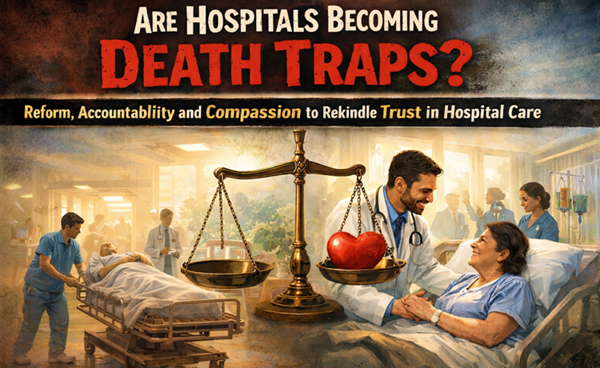
When routine surgeries turn fatal, while ICU bills soar, grieving families question whether hospitals are havens of healing or dangerously unsafe? Hospitals are neither temples nor traps—they are human institutions, capable of both remarkable healing and tragic failure. But reform, accountability, and compassion will help in rekindling trust in hospital care. OSWALD PEREIRA reports
Hospitals have long symbolised healing and hope. Yet, for some families, the experience of admitting a loved one—especially into an Intensive Care Unit (ICU)—has become fraught with fear.
Stories abound of patients admitted for treatable conditions—appendicitis, fractures, manageable infections—only to deteriorate rapidly in the ICU and return home lifeless. Coupled with soaring daily ICU charges that can exceed ₹1 lakh in private tertiary-care facilities in India, the question arises: are hospitals becoming “death traps,” or is the reality more complex?
The ICU Paradox
The ICU is designed for critically ill patients who require constant monitoring, ventilatory support, and life-saving interventions. Modern ICUs have significantly improved survival rates for severe conditions such as sepsis, trauma, and cardiac arrest. However, paradoxically, ICU admission itself carries risks.
Critically ill patients are vulnerable to hospital-acquired infections (HAIs), also known as nosocomial infections. According to the World Health Organization (WHO), hundreds of millions of patients worldwide are affected by HAIs each year, making them one of the most frequent adverse events in healthcare delivery.
In low and middle-income countries, the risk of acquiring an HAI can be two to three times higher than in high-income nations.
Ventilator-associated pneumonia (VAP), bloodstream infections, and catheter-related infections are among the most serious ICU-related complications. A study published in The Lancet Infectious Diseases reported that ICU patients face significantly higher infection rates due to invasive procedures and compromised immunity.
The “Hospital Bug” and Caregiver Risk

Families often speak of the “hospital bug”—a lay term referring to multidrug-resistant organisms (MDROs) that thrive in healthcare settings. Pathogens such as MRSA (Methicillin-resistant Staphylococcus aureus) and carbapenem-resistant Enterobacteriaceae are notoriously difficult to treat. The Centers for Disease Control and Prevention (CDC) estimates that antimicrobial-resistant infections cause over 35,000 deaths annually in the United States alone.
Caregivers, too, may face exposure risks, especially in crowded hospital environments where infection control protocols are inconsistently enforced. In India, overcrowding and limited nurse-to-patient ratios in some hospitals exacerbate this risk.
When Routine Cases Turn Critical

It is deeply distressing when patients admitted for relatively minor surgeries—such as appendectomy—or orthopedic repairs develop complications leading to ICU admission. Postoperative infections, anesthesia complications, undiagnosed comorbidities, or delayed recognition of sepsis can escalate otherwise manageable cases into life-threatening crises.
However, it is important to note that while tragic, such outcomes are statistically uncommon relative to the total volume of surgeries performed. According to data published in the Indian Journal of Anaesthesia, perioperative mortality rates in elective surgeries are relatively low but increase significantly in emergency procedures or in patients with underlying risk factors.
The Economics of Intensive Care
The financial dimension intensifies public mistrust. ICU care is inherently expensive due to specialised staff, equipment, and round-the-clock monitoring. In India’s private healthcare sector, ICU costs can range from ₹25,000 to over ₹1 lakh per day, depending on the facility and level of care.
Critics argue that prolonged ICU stays sometimes reflect defensive medicine or financial incentives rather than clear clinical benefit. Yet healthcare administrators counter that critically ill patients often require prolonged stabilisation, and high-end technologies—ventilators, dialysis machines, ECMO (Extracorporeal Membrane Oxygenation)—come at enormous operational costs.

The debate over overbilling and transparency has prompted regulatory scrutiny. The National Pharmaceutical Pricing Authority (NPPA) and other governmental bodies have intervened periodically to cap prices of essential medical devices and drugs. Nevertheless, billing opacity remains a common grievance among families.
Are Top-End Hospitals More Callous?
A widespread perception exists that large corporate hospitals are more profit-driven than smaller community facilities. High patient turnover, standardised protocols, and bureaucratic hierarchies may create an impression of impersonality.
However, large tertiary hospitals often handle the most complex and high-risk cases referred from smaller centers. Mortality rates may therefore appear higher, not necessarily due to negligence but because these institutions serve as referral hubs for the sickest patients. The phenomenon is known in health economics as “case-mix severity.”

That said, documented instances of negligence, lack of informed consent, and communication failures have eroded trust. Studies emphasise that transparent communication and shared decision-making significantly improve family satisfaction—even in cases where outcomes are poor.
Systemic Challenges in India
India’s healthcare system faces structural challenges: uneven distribution of resources, varying standards between public and private sectors, and limited regulatory enforcement in some regions. According to the NITI Aayog, India’s doctor-to-population ratio has improved but remains below ideal levels in many states.
Overburdened staff, burnout, and inadequate infection control infrastructure contribute to adverse outcomes. Globally, burnout among Intensive Care Unit (ICU) physicians—affecting approximately 30 per cent to over 60 per cent of staff—is strongly linked to increased medical errors, reduced patient safety, and lower quality of care. This high-stress environment, worsened during the COVID-19 pandemic.

A Balanced View
Labelling hospitals as “death traps” oversimplifies a complex issue. ICUs save millions of lives annually. Without them, survival from severe trauma, sepsis, or respiratory failure would be drastically lower. At the same time, legitimate concerns about infection control, overmedicalisation, high costs, and communication gaps cannot be dismissed.
The path forward lies in strengthening regulatory oversight, improving infection prevention practices, ensuring cost transparency, and fostering empathetic communication. Families must also be empowered with clear information about risks, prognosis, and alternative care pathways.
Hospitals are neither temples nor traps—they are human institutions, capable of both remarkable healing and tragic failure. Reform, accountability, and compassion will determine which image ultimately prevails.
References
- Vincent, J.L., et al. “International Study of the Prevalence and Outcomes of Infection in Intensive Care Units.” JAMA, 2009.
- World Health Organization. “Health care-associated infections Fact Sheet.”
- Allegranzi, B., et al. “Burden of Endemic Health-Care-Associated Infection in Developing Countries.” The Lancet, 2011.
- The Lancet Infectious Diseases, ICU infection studies.
- Centers for Disease Control and Prevention. “Antibiotic Resistance Threats Report,” 2019.
- Mehta, Y., et al. “Device-Associated Infection Rates in Indian ICUs.” Indian Journal of Critical Care Medicine, 2014.
- Gawande, A. Complications: A Surgeon’s Notes on an Imperfect Science.
- “Perioperative Mortality in India.” Indian Journal of Anaesthesia, 2017.
- Indian private hospital billing data reports, various state health authorities.
- National Pharmaceutical Pricing Authority notifications.
- Iezzoni, L.I. Risk Adjustment for Measuring Health Care Outcomes.
- Curtis, J.R., et al. “Communication in the ICU.” American Journal of Respiratory and Critical Care Medicine, 2004.
- NITI Aayog Health Index Report.
- National Academy of Medicine.
 OSWALD PEREIRA