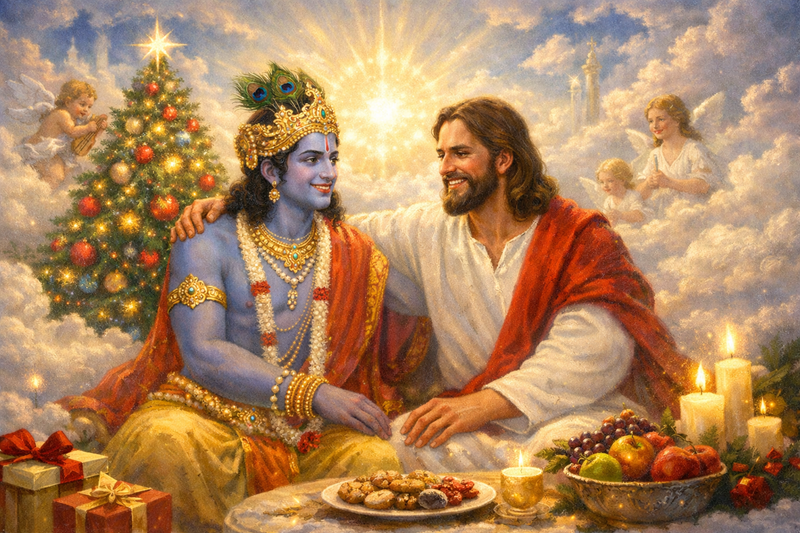
As we celebrate Christmas, let us reaffirm the holy Krishna-Christ connection, says OSWALD PEREIRA. Paramahansa Yogananda often quoted verses from the Bible and the Gita to show the similarities between the verses, thus establishing the unity between the two scriptures, and between Krishna and Christ
Swami Vivekananda and his guru Sri Ramakrishna both believed in a Krishna-Christ connection. Paramhansa Yogananda, too, was a strong believer in the creed of a Krishna-Christ Connection.
To Yogananda must go the credit for giving to the world the most detailed exposition on the creed of a Krishna-Christ Connection in his talks and writings. This creed is a recurrent theme in his book, The Second Coming of Christ: The Resurrection of the Christ Within You, published posthumously in two volumes of 1696 pages, in 2004, by Self-Realization Fellowship.
At his first speech given in America at the Congress of Religious Liberals in 1920, Yogananda “announced that he would be giving weekly classes in Boston that would consist of three parts,” according to the website, https://ocoy.org. The three parts were “a half-hour exposition of the Bhagavad Gita, a half-hour exposition of the Gospels, followed by a half-hour discourse demonstrating their fundamental unity.”

In the thirty-two years after that “first speech, he never deviated from his intention, and often stated that his purpose in coming to America was to present Original Yoga and Original Christianity,” the website observed.
After establishing a magazine (East-West), he began “publishing a series of articles on the Gita and another series on the Gospels, which even then he called The Second Coming of Christ,” the website https://ocoy.org noted, adding, “Toward the end of his life he wanted them collected and printed in a book, but found that a tremendous amount of editing was needed, so that was not done.”
The Second Coming of Christ tells the story of Jesus Christ’s life in chronological order. The book describes Christ’s birth, travels, ministry, parables, death, and his resurrection. Yogananda discusses a link between Kriya Yoga and the teachings of Jesus in the book.
Yogananda affirmed that a “point by point” comparison of the teachings of the Bhagavad Gita and the Bible reveal a “harmonious unity” between the two scriptures.

Yogananda reveals that every word in the book is inspired and written by Christ himself, whom he communicated with in numerous visions that he saw of the great avatar as “Baby Jesus” and when he was a teacher and Master to his scores of disciples.
In his 1929 book, Whispers from Eternity, Yogananda describes his vision of Krishna-Christ, walking hand in hand. The exquisite and soul-stirring vision stays long with the reader.
Yogananda writes: “I beheld a great blue valley encircled by mountains that shimmered jewel-like. Around opalescent peaks, vagrant mists sparkled. A river of silence flowed by, diamond-bright. And there I saw, coming out of the depths of the mountains, Jesus and Krishna walking hand in hand. It was the same Christ who prayed by the river Jordan and Christna who played a flute by the river Jamuna.
“They baptized me in the radiant waters, my soul melted in fathomless depths. Everything began to emit astral flames. My body and the forms of Christ and Krishna, the iridescent hills, the glowing stream, and the far empyrean became dancing lights, while atoms of fire flew. Finally nothing remained but mellow luminosity, in which all creation trembled.”

Indeed, such visions of Krishna and Christ together, strengthened Yogananda’s belief in a Krishna-Christ connection.
The deep relationship between Krishna and Christ forms an important part of Yogananda’s philosophy and teachings. Many verses from the Bhagavad Gita and the Bible match, affirms Yogananda.
Yogananda, the great proponent of unity of religions, elaborates that Jesus’ teachings are synonymous with core Vedic teachings, which were propagated long before Jesus was born. Truth is eternal. Both avatars had embraced this eternal nature of truth.
Yogananda’s Second Coming of Christ gives credence to the thought that Jesus took birth to give the inhabitants of a different era long after the time of the Gita, the truths expounded in Indian scriptures. The evergreen principle of righteousness is apparent in the Book of Genesis and in the sacred Hindu text. The central idea in many a talk that he gave to his students touched upon the different interpretations of the same truth from the One God emanating from Bhagavan Krishna and from Jesus.
Yogananda thus showed the world how you could follow the Bhagavad Gita or the Bible or both and lead a good life that would please God, as both religious texts propounded the same truths and values.

Yogananda makes the point repeatedly that while ethics and morals expounded by the two scriptures overlap, the difference lies only in the language they were presented in―one in Sanskrit and the other in Hebrew for the Old Testament and Greek for the New Testament, translated into English. Yogananda believed the version of historians that Jesus spent more than fifteen years in India and Tibet, studying ancient scriptures with teachers there. Back then, India was considered the “spiritual highland of the earth.”
Yogananda talks rapturously of the Krishna-Christ connection. His teachings focused on how Krishna and Christ complemented each other, being incarnations, as they represented the One God’s love and compassion. Both the Gita and the Bible are handbooks for living life on earth, as moral and upright children of God.
Yogananda cites documents discovered by Nicolas Notovitch, which prove that Jesus, indeed, spent a considerable amount of time in India with the rishis who imparted to him the knowledge of the Vedas. The three wise men from the East journeyed across deserts to hail Baby Jesus in the manger where he was born. According to Yogananda, the three wise men were Mahavatar Babaji, Lahiri Mahasaya and Sri Yukteswar in previous lives.
Jesus after partaking of the wisdom of the East, went back to Palestine to spread his teachings there. Eventually, his teachings spread to the rest of the world, who believed that Christ was their saviour.
Emphasising that Jesus is a bridge between the East and the West, Yogananda said: “This great Christ, radiating the spiritual strength and power of the Orient to the West, is a divine liaison to unite God-loving peoples of East and West.”
Yogananda often quotes his revered guru, Swami Sri Yukteswar, to establish the Krishna-Christ Connection. Sri Yukteswar was assigned by Babaji to write a book on the subject, which was completed in record time. Sri Yukteswar in the Introduction to his 1894 book, The Holy Science says that although there is unity in all religions, “this basic truth is one that is not easily comprehended.”
He writes: “The discord existing between the different religions, and the ignorance of men, make it almost impossible to lift the veil and have a look at this grand verity. The creeds foster a spirit of hostility and dissension; ignorance widens the gulf that separates one creed from another. Only a few specially gifted persons can rise superior to the influence of their professed creeds and find absolute unanimity in the truths propagated by all great faiths.”
Sri Yukteswar drew parallels between a host of sutras in Sanskrit from the Upanishads to verses and passages from the Holy Bible in his book to prove how the two scriptures complement each other. Yogananda by writing the Second Coming of Christ was following in his guru’s footsteps.
Yogananda often quoted verses from the Bible and the Gita to show the similarities between the verses, thus establishing the unity between the two scriptures.
As we celebrate Christmas today, let us reaffirm the holy Krishna-Christ connection.
Note: This article has been adapted from my book, Beyond Autobiography of a Yogi, published by Vitasta Publishing.
Order your copy of the book on
Amazon India: https://www.amazon.in/dp/8119670582
Amazon USA: https://rb.gy/np8ai1
Oswald Pereira, a senior journalist, has written ten books, including Beyond Autobiography of a Yogi, The Newsroom Mafia, Chaddi Buddies, The Krishna-Christ Connexion, How to Create Miracles in Our Daily Life and Crime Patrol: The Most Thrilling Stories. Oswald is a disciple of Paramhansa Yogananda, and practises Kriya Yoga.
 OSWALD PEREIRA